





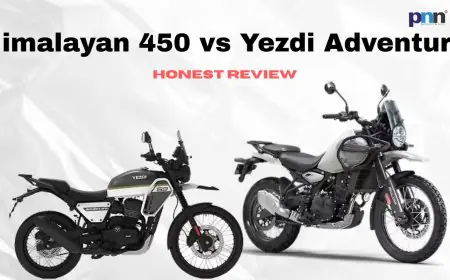















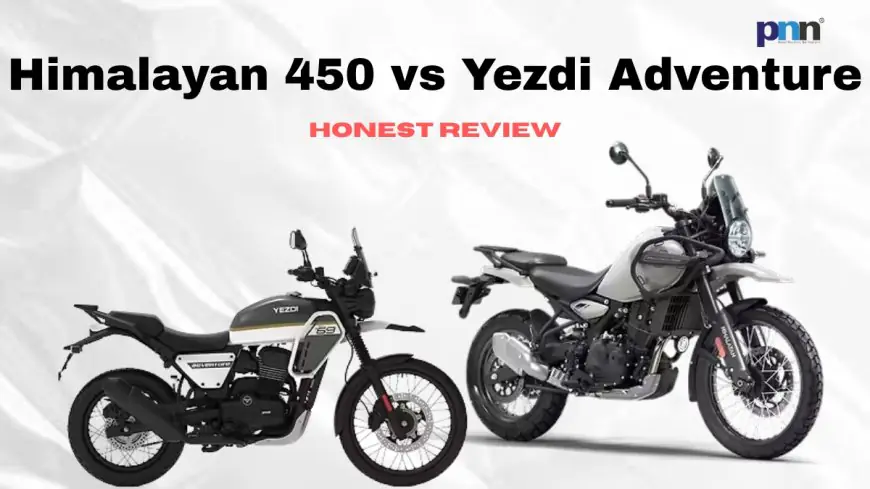
Himalayan 450 vs Yezdi Adventure
Detailed Comparison, Real-World Riding Review, Price Breakdown, and Which Adventure Bike Actually Makes Sense You look at price first because that’s unavoidable. The Himalayan 450 sits higher on the invoice. You pay more upfront. On paper that seems like a disadvantage. The reality is you pay for a bigger tank, a more developed chassis, a [...]


Detailed Comparison, Real-World Riding Review, Price Breakdown, and Which Adventure Bike Actually Makes Sense
You look at price first because that’s unavoidable. The Himalayan 450 sits higher on the invoice. You pay more upfront. On paper that seems like a disadvantage. The reality is you pay for a bigger tank, a more developed chassis, a brand with deeper service reach, and parts that actually exist in third-tier towns. This is not romance. This is travel math. The Yezdi Adventure is cheaper, yes—but you trade certainty for a lower sticker. In cities it barely matters. In real distance, it does.
Engine & Performance
Himalayan 450:
-
What you get: torque that never spikes, power you can predict in dust, gravel, pavement.
-
Price factor: you pay extra for that broad, tractable powerband.
-
Con: no fireworks. Overtaking takes patience.
Yezdi Adventure:
-
What you get: punchier feel, eager midrange that feels quicker in short bursts.
-
Price factor: cheaper engine package, less refinement.
-
Con: sharp throttle means you’re always managing vibration and heat.
Clutch & Gearbox
Himalayan:
-
You get a light, progressive clutch. Gearbox is functional, not slick.
-
On-road price value: you spend less mental energy crawling through traffic or slow trails.
-
Con: shifts are not precision-machine smooth.
Yezdi:
-
You get crisper shifts, heavier clutch.
-
Lower price means less refinement in leverage and modulation.
-
Con: harder to modulate in slow, technical sections.
Chassis & Stability
Himalayan:
-
You get planted straight-line behavior. Works over broken surfaces.
-
Price here buys stability and predictable compliance.
-
Con: slower direction changes on twisty tar.
Yezdi:
-
You get sharper turn-in. On clean roads it feels more agile.
-
Lower price compromises settle-down composure on uneven surfaces.
-
Con: you’re always correcting.
Suspension
Himalayan:
-
Pros: compliant, absorbs rubble, predictable response.
-
Price buys comfort over long days.
-
Con: gives little feedback for aggressive riding.
Yezdi:
-
Pros: firmer, feels controlled on smooth roads.
-
Price factor: cheaper damping tech, so sharp feedback on bad surfaces.
-
Con: endurance fatigue starts early.
Braking
Himalayan:
-
Pros: progressive, easy to modulate off-road.
-
Price investment buys confidence under varied traction.
-
Con: weak initial bite at speed.
Yezdi:
-
Pros: stronger bite on road.
-
Price reduces refinement in modulation.
-
Con: demands precision off road.
Ergonomics & Comfort
Himalayan:
-
You get neutral posture, wide bars, seat that won’t fight you after hours.
-
Price is partly for that long-distance thoughtfulness.
-
Con: seat is firm, not cushy.
Yezdi:
-
You get a compact, sporty feel.
-
Price buys style and initial comfort.
-
Con: comfort fades over extended stints.
Heat & Vibration
Himalayan:
-
Pros: managed heat, low vibration.
-
Price buys internal balancing and smoother mounts.
-
Con: engine feels muted to enthusiasts.
Yezdi:
-
Pros: alive feel.
-
Price means more heat transmission and buzz.
-
Con: fatigue over hours.
Fuel Range & Ownership
Himalayan:
-
Large tank, better mileage.
-
Price includes parts network deeper in small towns.
-
Con: you pay more now for less worry later.
Yezdi:
-
Smaller tank; range acceptable but tight on long runs.
-
Price lower, but parts and service reach are still growing.
-
Con: long trip logistics require planning.
This isn’t a choice between nice things. It’s a ledger of trade-offs you’ll feel in your hands and hips. The Himalayan costs more because it gives you less to fight with on real distance. The Yezdi costs less but gives you more to manage as you ride. That’s the real price equation, and it’s the only one that matters once you’re on the road.
What's Your Reaction?